Research library / Compounds
What is ?
Three amino acids with an unusual bond, and the most abundant small thiol inside cells.
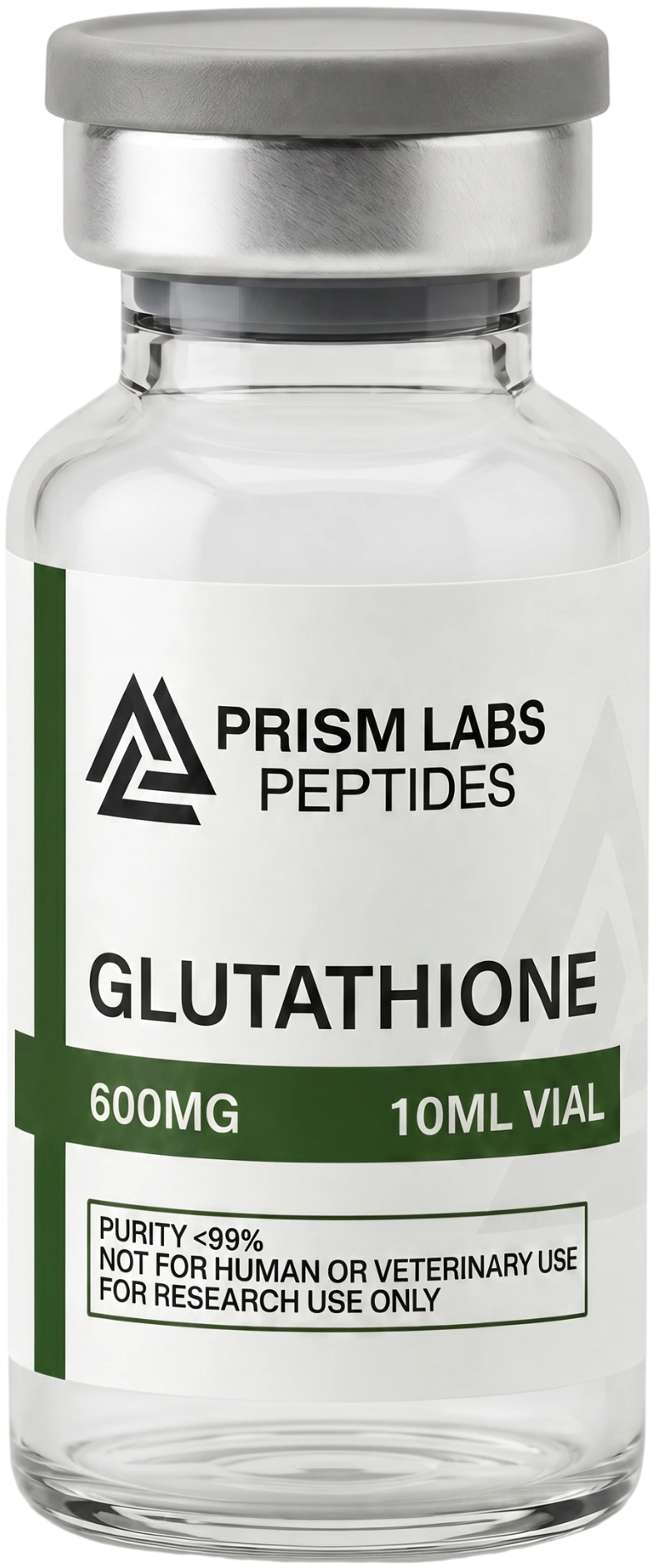
is a tripeptide made from glutamate, cysteine and glycine. It is the most abundant low-molecular-weight thiol in cells, where it helps maintain redox balance and reacts with oxidants and electrophiles. Prism Labs supplies it as a 600 mg lyophilized vial.
01
What it is
Its full chemical name is γ-L-glutamyl-L-cysteinylglycine. The reference record lists the formula C10H17N3O6S and a molecular weight of 307.33 g/mol (PubChem CID 124886).
The γ (gamma) is the unusual part. Glutamate is joined to cysteine through its side-chain carboxyl group instead of the usual backbone one, so the first link is not a standard peptide bond.
The thiol (–SH) group on cysteine does the chemical work, which is why the reduced form is abbreviated GSH.
Sources: [1] PubChem · reference structure · [2] Molecular Aspects of Medicine · 2009
02
Reduced and oxidized: GSH and GSSG
Two GSH molecules can give up electrons and join through a disulfide bond, forming the oxidized form, GSSG.
The ratio of GSH to GSSG is a common measure of a sample’s redox state. A 1969 enzymatic method for measuring the total and oxidized forms is still widely cited; chromatography and mass spectrometry are now used as well.
Research material is labeled as the reduced or oxidized form, and the identity result on the COA confirms which one a lot contains.
Sources: [2] Molecular Aspects of Medicine · 2009 · [3] Analytical Biochemistry · 1969 · [4] Journal of Chromatography B · 2009
03
How cells make it
Cells build it from its three amino acids in two enzyme-driven steps and recycle GSSG back to GSH. A 2009 overview and a 2024 review describe the synthesis and how it is regulated.
The 2024 review also notes a quieter job: it serves as a store of cysteine.
Sources: [2] Molecular Aspects of Medicine · 2009 · [5] Current Medicinal Chemistry · 2024
04
What researchers have studied
The literature is enormous. Main laboratory themes:
- Protection of cells against oxidants and reactive electrophiles.
- Redox balance, with the GSH/GSSG ratio as a marker.
- Detoxification reactions in which it is attached to foreign compounds.
- Measurement methods, from enzymatic assays to mass spectrometry.
These are observations in laboratory models. They are not evidence about any use in people.
Sources: [2] Molecular Aspects of Medicine · 2009 · [5] Current Medicinal Chemistry · 2024 · [3] Analytical Biochemistry · 1969 · [4] Journal of Chromatography B · 2009
05
How it is supplied and stored
ships as a lyophilized (freeze-dried) powder in 600 mg vials. The powder is stable at room temperature in transit. For lab use it is reconstituted with bacteriostatic water such as .
Concentration is content divided by volume: 600 mg in 6 mL gives 100 mg per mL. The reconstitution calculator handles other combinations.
For storage before and after reconstitution, see how to store lyophilized peptides.
06
How to verify a batch
Every lot has its own certificate of analysis from an independent lab. Read three results separately:
- Identity: confirms the expected compound was detected.
- Purity: the share of the measured material that is the intended compound.
- Content: the amount measured, compared with the label.
Then match the lot number on your vial or bottle to the report, and use the report’s verification link to confirm it with the testing lab. Step by step: how to read a peptide COA.
A little more clarity
Questions, answered
What is ?
A tripeptide of glutamate, cysteine and glycine, and the most abundant low-molecular-weight thiol in cells.
Is a peptide?
Yes, a tripeptide, though an unusual one: its first link runs through glutamate’s side chain rather than a standard peptide bond.
What is the difference between GSH and GSSG?
GSH is the reduced form, with a free thiol group. Two GSH molecules joined by a disulfide bond make GSSG, the oxidized form.
What sizes are available?
A 600 mg lyophilized vial, each lot with its own COA.
Is it for human use?
No. Prism Labs sells it for laboratory research use only.
Follow the evidence
Sources & reading notes
Open the original record for its methods and limitations. The sources below do not certify the supplied product or its finished formulation.
- PubChem · reference structure ↗
Reduced form, γ-L-glutamyl-L-cysteinylglycine; not a measurement of the supplied batch.
- Molecular Aspects of Medicine · 2009 ↗
Overview of its protective roles, how it is measured and how cells make it.
- Analytical Biochemistry · 1969 ↗
Enzymatic recycling method for measuring the total and oxidized forms.
- Journal of Chromatography B · 2009 ↗
Chromatographic and mass-spectrometric methods for biological samples.
- Current Medicinal Chemistry · 2024 ↗
Review of its synthesis, metabolism and functions.
Prepared by Prism Labs from the linked source records and public product documentation. Research context only; not a preparation protocol or a claim about outcomes. Send a source correction.
Keep exploring
More from the research library.
The first 29 of human GHRH’s 44 amino acids, with nothing added.
Read the article ↗Compounds
A lipid-linked peptide built to act on two related hormone receptors at once.
Read the article ↗Compounds
Part of the hormone α-MSH, rebuilt in 1989 as a cyclic seven-residue peptide to study melanocortin receptors.
Read the article ↗