Research library / Compounds
What is ?
A 29-residue amidated fragment and its sequence-comparison research.
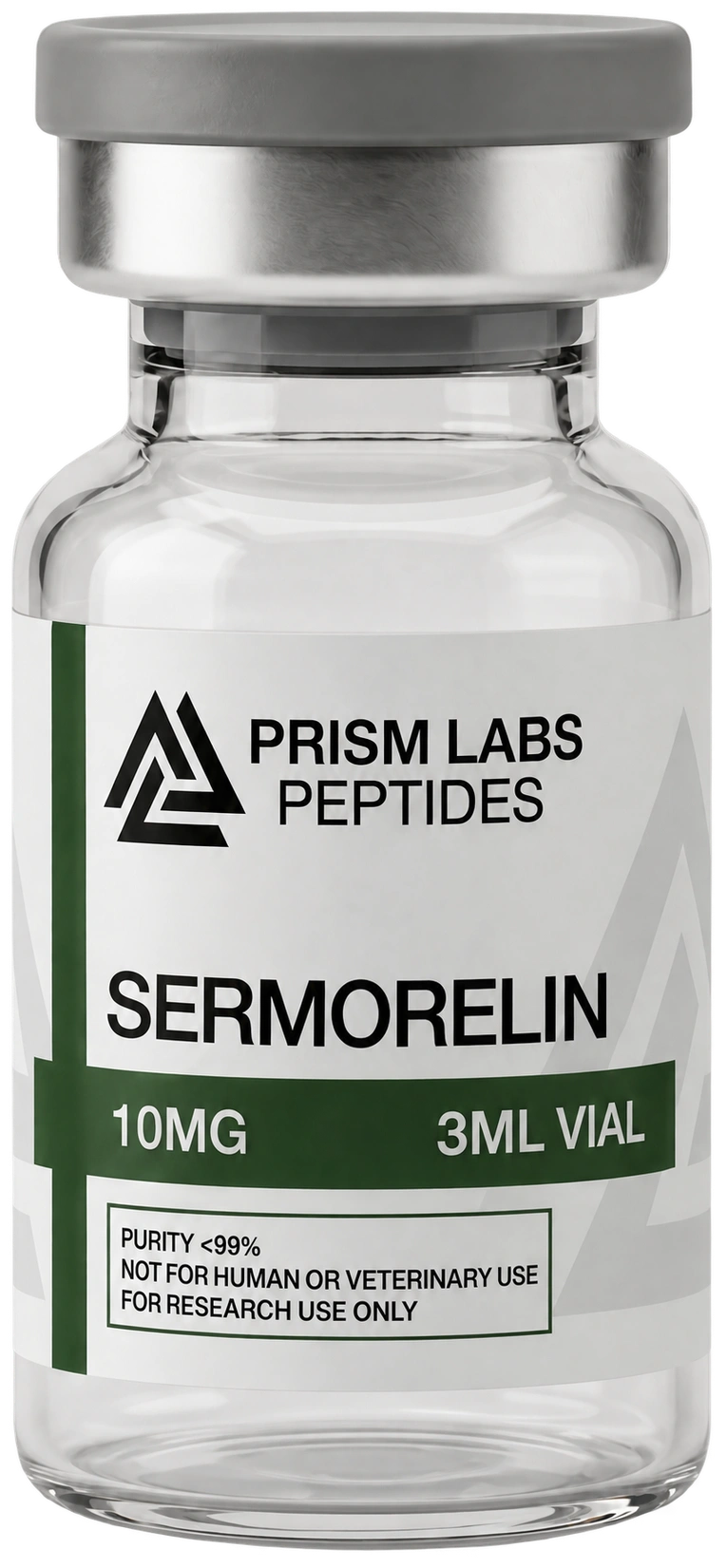
is the amidated 29-residue fragment commonly called GHRH(1–29). Its research literature examines growth-axis signaling and the effects of changing a peptide's sequence or terminal groups. The listed 10 mg vial is coming soon.
01
Reference structure
The PubChem reference has formula C149H246N44O42S and molecular weight 3357.9 g/mol. The terminal amide is part of that reference structure; a supplied salt or counterion would require separate documentation.
Sources: [1] PubChem · reference structure
02
Sequence and signaling research
A 1984 synthesis study compared the 1–29 amide with modified analogues in rat and pig experiments. Another study that year examined how removing residues from the parent sequence changed activity in vitro.
These papers concern defined experimental preparations and comparative models. They do not establish the identity, purity or performance of Prism Labs stock.
Sources: [2] Biochemical and Biophysical Research Communications · 1984 · [3] Biochemical and Biophysical Research Communications · 1984
03
The listed research format
The catalog lists 10 mg lyophilized powder vials for laboratory research. These are labeled quantities; the batch report lists measured content separately.
For laboratory concentration arithmetic, use the reconstitution calculator. Concentration is the amount of material divided by the solution volume; it is not a dosing instruction.
Handling and storage should follow the lab's validated procedure. Read the storage guide for the differences between dry material and a prepared solution.
04
Batch documentation
The first shipment is incoming and sales are paused. Batch certificates dated October 1, 2026 are available on the product page, with identity, purity, measured content and additional test results for the reported samples.
A database structure describes a reference molecule. It does not identify a particular supplied vial, establish its salt form or replace independent batch testing.
Match the report's labeled strength and lot number, and compare identity, purity and content results separately. See how to read a peptide COA.
A little more clarity
Questions, answered
What is ?
An amidated 29-amino-acid fragment used in growth-axis signaling research.
Which sizes are listed?
10 mg lyophilized research vials.
Are sales open?
No. The incoming products are listed as coming soon with sales paused.
Is a batch report available?
Yes. The product page links batch reports dated October 1, 2026. Match the labeled strength and lot number when checking a report. Reference structures and published papers are not batch certificates.
Is it for human use?
No. Prism Labs sells it for laboratory research use only.
Follow the evidence
Sources & reading notes
Open the original record for its methods and limitations. The sources below do not certify the supplied product or its finished formulation.
- PubChem · reference structure ↗
The structure referenced in the product specifications; not a measurement of the supplied batch.
- Biochemical and Biophysical Research Communications · 1984 ↗
Synthesis and comparison of modified 1–29 amide analogues in animal models.
- Biochemical and Biophysical Research Communications · 1984 ↗
Sequence truncation and in-vitro activity of related fragments.
Prepared by Prism Labs from the linked source records and public product documentation. Research context only; not a preparation protocol or a claim about outcomes. Send a source correction.
Keep exploring
More from the research library.
A lipid-linked peptide examined through receptor structures and signaling models.
Read the article ↗Compounds
A cyclic seven-residue peptide and the chemistry of its ring.
Read the article ↗Compounds
A short synthetic fragment, its reference mass and the limits of animal models.
Read the article ↗