Research library / Comparisons
vs : what is the difference?
One keeps the whole hormone and protects its start. The other keeps only the first 29 amino acids.
and are both synthetic analogues of growth hormone-releasing hormone (GHRH), the hormone that signals the pituitary to release growth hormone. One keeps all 44 amino acids and protects the start of the chain; the other keeps only the first 29. Here is how they compare, and where and fit.
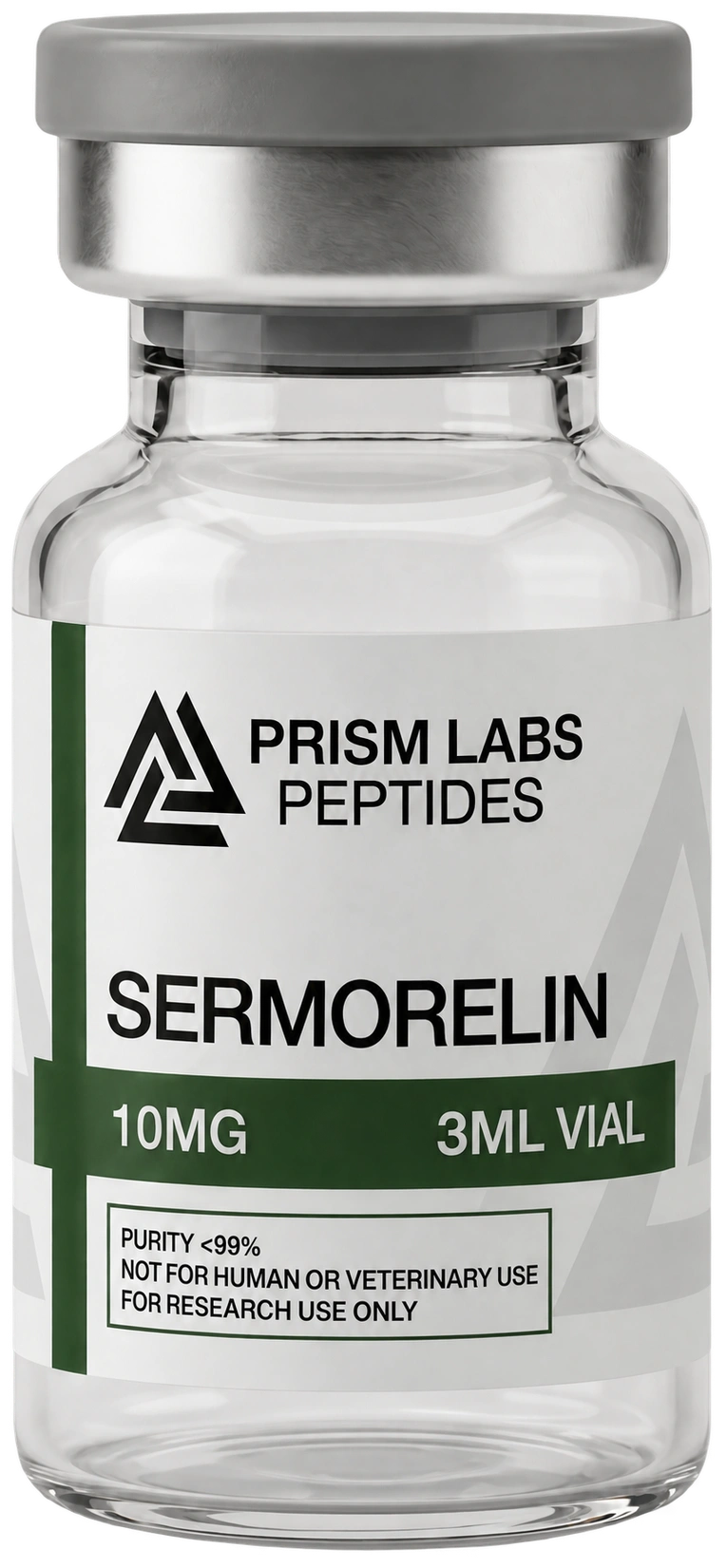
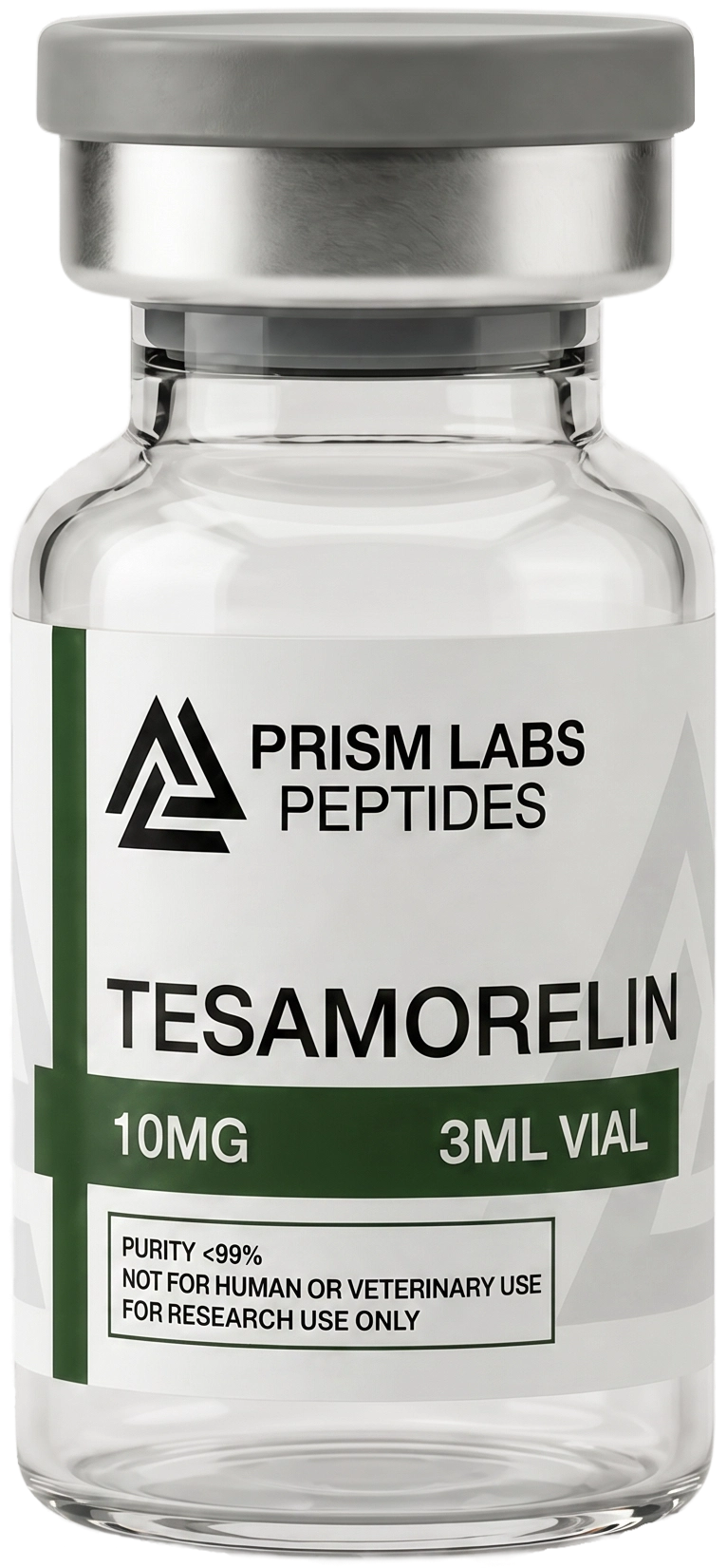
Side by side
| Detail | ||
|---|---|---|
| Format | Lyophilized vial | Lyophilized vial |
| Listed sizes | 10mg | 10mg |
| Price | $64.99 per vial | $64.99 per vial |
| Availability | In stock | In stock |
| Reported purity | 99.53% | 99.75% |
| Latest batch report | October 1, 2026 · lot 780030 | September 23, 2026 · lot 118142 |
| Reference formula | C149H246N44O42S | C221H366N72O67S |
| Reference weight | 3357.9 g/mol | 5136 g/mol |
| Reference sequence | YADAIFTNSYRKVLGQLSARKLLQDIMSR | YADAIFTNSYRKVLGQLSARKLLQDIMSRQQGESNQERGARARL |
| Reference CAS number | 86168-78-7 | 218949-48-5 |
Catalog figures, current at page load. Published batch reports cover past lots and do not name the lot a new order ships with.
and — how much does each cost?
: $64.99 per vial. : $64.99 per vial. Packs discount every vial in the order: 2 vials 5% off, 3 vials 10% off, 5 vials 14% off, 10 or more vials 18% off. Free standard shipping on orders over $125.
Where to buy and
Both are for sale direct from Prism Labs, USA made, with the batch Certificate of Analysis published on each product page. Orders placed before 4:30 PM CT ship the same day, seven days a week, when inventory is available.
and — are they in stock?
: in stock. : in stock. Each product page carries live availability.
01
At a glance
The main differences in one list:
- Length: all 44 amino acids of GHRH for ; the first 29 for .
- Added group: a trans-3-hexenoyl chain on the first amino acid of ; none on .
- Reference formula: C221H366N72O67S (about 5,136 g/mol) versus C149H246N44O42S (about 3,358 g/mol).
- Stability: the plasma enzyme DPP-IV cuts the start of ; resisted it in a 2007 study.
- Formats at Prism Labs: both as 10 mg lyophilized vials.
Sources: [2] PubChem · reference structure · [1] PubChem · reference structure · [4] Journal of Clinical Investigation · 1989 · [5] Basic & Clinical Pharmacology & Toxicology · 2007

03
Length versus protection
The natural hormone breaks down quickly in blood. A 1989 study traced the main cut to the enzyme dipeptidyl peptidase IV (DPP-IV), which splits the chain between its second and third amino acids, and found the same cut in the 1–29 amide.
is the hormone made shorter, not sturdier: in 1984 rat pituitary-cell experiments it kept about half the full hormone’s potency, but nothing protects its first two amino acids.
keeps the full length and protects the start: in a 2007 preclinical paper, its hexenoyl group resisted DPP-IV and slowed breakdown in rat, dog and human plasma. Even so, its half-life in dogs was 21 to 45 minutes.
Sources: [4] Journal of Clinical Investigation · 1989 · [3] Biochemical and Biophysical Research Communications · 1984 · [5] Basic & Clinical Pharmacology & Toxicology · 2007
05
How their research differs
Their literatures overlap less than their sequences:
- : 1980s structure–activity work in rat pituitary cells, and where plasma enzymes cut it.
- : plasma stability and repeat-dose studies in rats, dogs and pigs (2007), then clinical studies covered in its profile.
- Both: urine detection methods (2021).
These are observations in laboratory models. They are not evidence about any use in people.
Sources: [3] Biochemical and Biophysical Research Communications · 1984 · [4] Journal of Clinical Investigation · 1989 · [5] Basic & Clinical Pharmacology & Toxicology · 2007 · [7] Drug Testing and Analysis · 2021
06
Formats and full profiles
Both ship as 10 mg lyophilized vials, reconstituted with bacteriostatic water such as . Each lot has its own certificate of analysis: how to read a peptide COA.
Full profiles: What is ? and What is ?
The secretagogue on its own: What is ?
A little more clarity
Questions, answered
What is the difference between and ?
Length and one added group. is the first 29 amino acids of GHRH; has all 44, plus a trans-3-hexenoyl group that protects its start from the enzyme DPP-IV.
Is a longer version of ?
In sequence, yes: its first 29 amino acids match. With 15 more and an added group, it is a separate molecule.
Is the same as ?
No. is a GHRH analogue; is a five-residue peptide acting through the receptor ghrelin uses.
How is different from ?
Both use the same 29 amino acids, but has four substituted, and one version adds an albumin-binding group (DAC). is unmodified.
Are they for human use?
No. Prism Labs sells both for laboratory research use only.
Follow the evidence
Sources & reading notes
Open the original record for its methods and limitations. The sources below do not certify the supplied product or its finished formulation.
- PubChem · reference structure ↗
Reference structure of the 29-residue analogue; not a batch measurement.
- PubChem · reference structure ↗
Reference structure of the 44-residue analogue; not a batch measurement.
- Biochemical and Biophysical Research Communications · 1984 ↗
Activity of shortened fragments, including the 1–29 amide, in rat pituitary cells.
- Journal of Clinical Investigation · 1989 ↗
DPP-IV cleavage of GHRH and the 1–29 amide in plasma.
- Basic & Clinical Pharmacology & Toxicology · 2007 ↗
Preclinical stability, pharmacology and safety of the hexenoyl-modified 44-residue analogue.
- Endocrinology · 2005 ↗
Albumin-binding analogues of the 1–29 sequence in rats.
- Drug Testing and Analysis · 2021 ↗
Anti-doping detection of four GHRH analogues and their metabolites.
- European Journal of Endocrinology · 1998 ↗
Development and receptor profile of the five-residue secretagogue.
- Nature · 1999 ↗
Discovery of ghrelin, the natural ligand of the secretagogue receptor.
Prepared by Prism Labs from the linked source records and public product documentation. Research context only; not a preparation protocol or a claim about outcomes. Send a source correction.
Keep exploring
More from the research library.

vs
Two seven-residue peptides with the same tail and different parents.
Read the article ↗Comparisons
vs
Two unrelated peptides that keep turning up in the same studies.
Read the article ↗Comparisons
vs
Two blends that share three peptides. One extra ingredient makes the difference.
Read the article ↗