Research library / Compounds
What is ?
A five-residue peptide described in 1998 as the first selective growth hormone secretagogue.
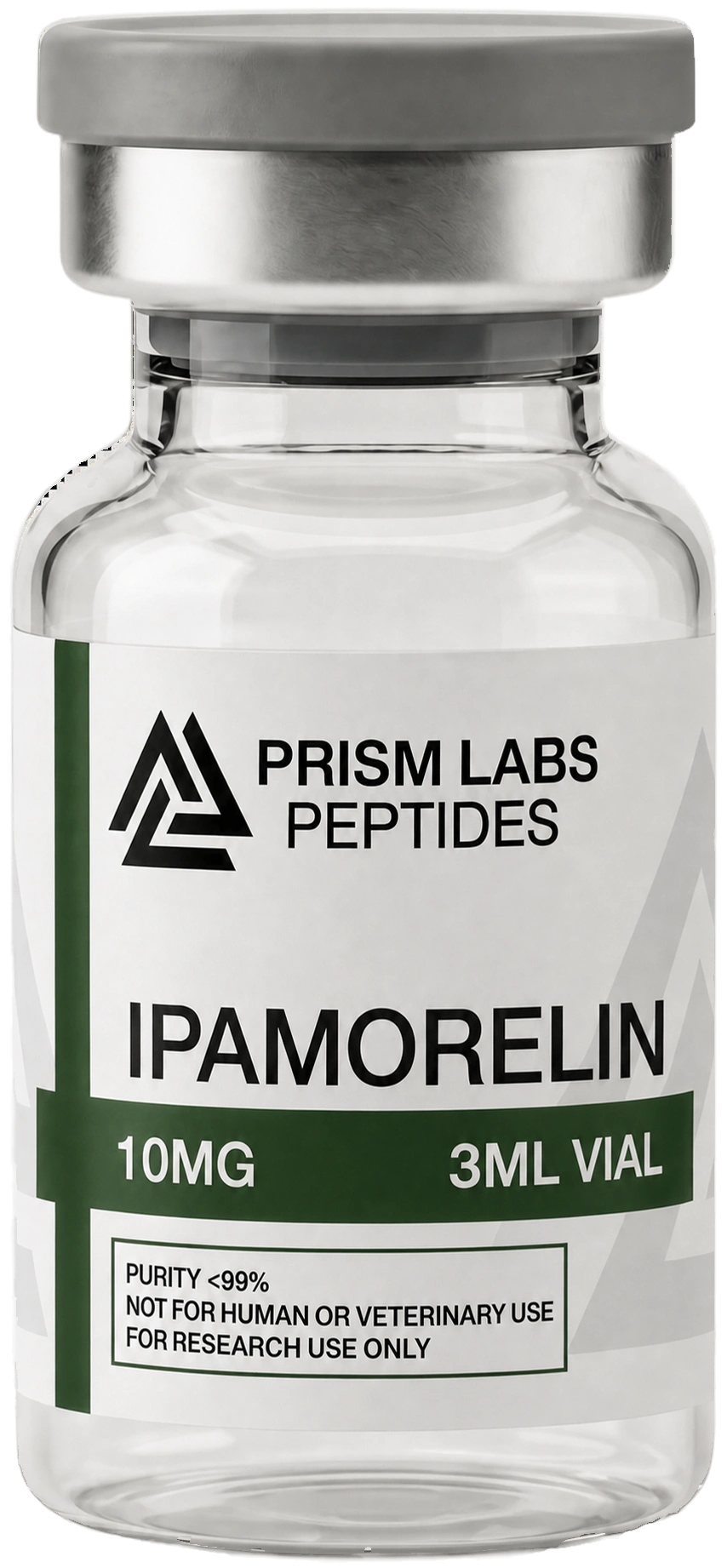
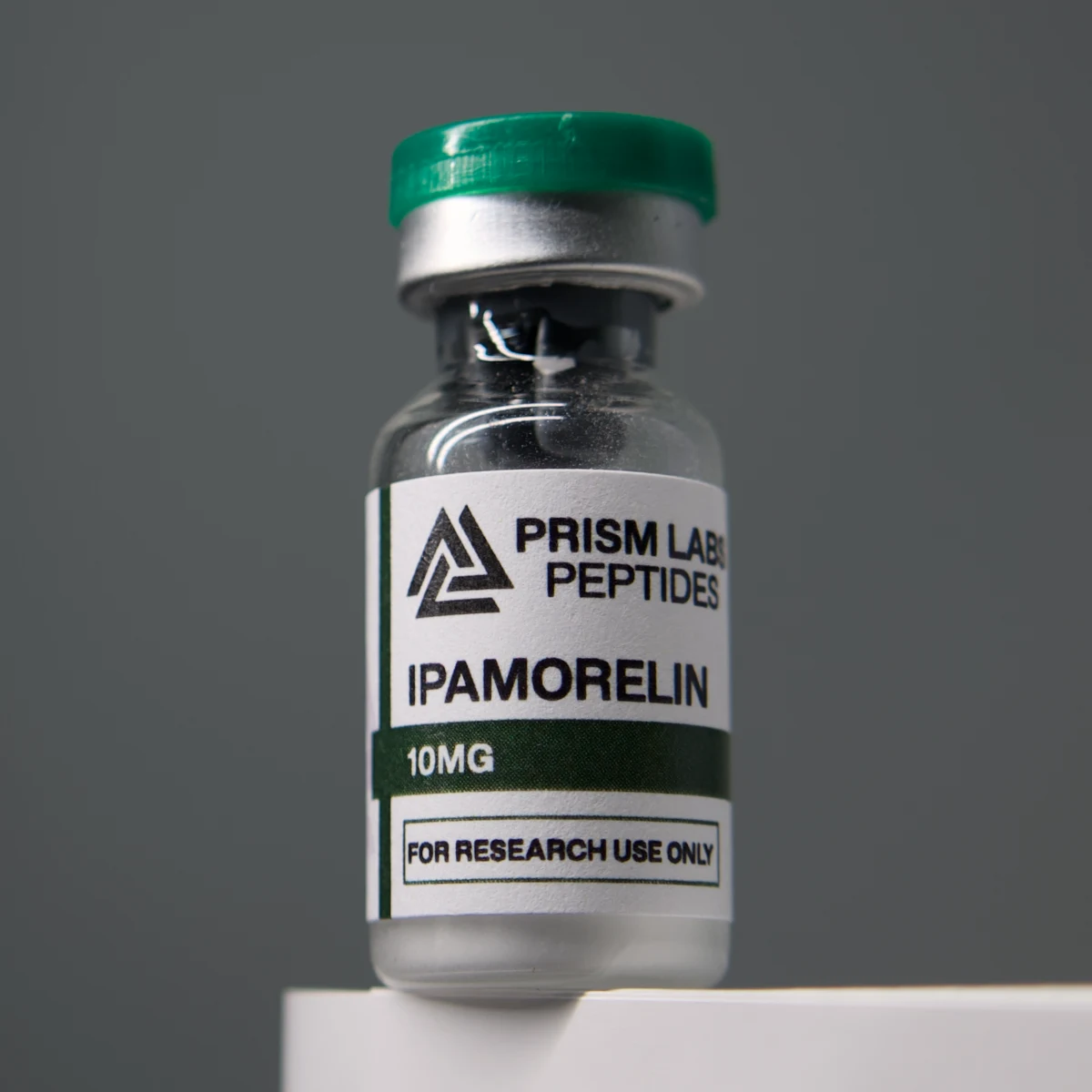
is a synthetic pentapeptide that causes the pituitary to release growth hormone. Novo Nordisk scientists described it in 1998 as the first selective growth hormone secretagogue, because in their animal studies it released growth hormone without raising stress hormones. Prism Labs supplies it as a 10 mg lyophilized vial.
01
What it is
Its sequence is Aib–His–D-2-Nal–D-Phe–Lys–NH2. Three of the five residues are non-standard: Aib (α-aminoisobutyric acid), D-2-naphthylalanine and D-phenylalanine. The reference record lists the formula C38H49N9O5 and a molecular weight of 711.9 g/mol (PubChem CID 9831659).
Sources: [1] PubChem · reference structure · [2] European Journal of Endocrinology · 1998
02
Where it came from
It came from a Novo Nordisk chemistry program built on the growth hormone-releasing peptides (GHRPs), small synthetic peptides known to release growth hormone. It was identified in a series of compounds lacking the Ala–Trp pair at the center of GHRP-1.
In 1999, researchers identified the body’s own ligand for the receptor these peptides act on: ghrelin, a 28-amino-acid peptide from the stomach.
Sources: [2] European Journal of Endocrinology · 1998 · [3] Nature · 1999
03
What “selective” means
Earlier GHRPs released growth hormone but also raised ACTH and cortisol. In the 1998 swine studies, GHRP-6 and GHRP-2 did both, while did not raise ACTH or cortisol beyond the levels seen with GHRH itself, even at many times the amount needed to release growth hormone.
None of the secretagogues tested changed FSH, LH, prolactin or TSH. That profile, similar to GHRH’s, is why the paper called it the first selective growth hormone secretagogue.
04
What researchers have studied
Most of its literature is preclinical:
- Growth hormone release in rat pituitary cells, anesthetized rats and swine, in the 1998 paper.
- Longitudinal bone growth in rats, in 1999.
- The ghrelin receptor (GHS-R) it acts through.
These are observations in laboratory models. They are not evidence about any use in people. It is also one half of .
Sources: [2] European Journal of Endocrinology · 1998 · [4] Growth Hormone & IGF Research · 1999 · [3] Nature · 1999
05
How it is supplied and stored
ships as a lyophilized (freeze-dried) powder in 10 mg vials. The powder is stable at room temperature in transit. For lab use it is reconstituted with bacteriostatic water such as .
Concentration is content divided by volume: 10 mg in 2 mL gives 5 mg per mL. The reconstitution calculator handles other combinations.
For storage before and after reconstitution, see how to store lyophilized peptides.
06
How to verify a batch
Every lot has its own certificate of analysis from an independent lab. Read three results separately:
- Identity: confirms the expected compound was detected.
- Purity: the share of the measured material that is the intended compound.
- Content: the amount measured, compared with the label.
Then match the lot number on your vial or bottle to the report, and use the report’s verification link to confirm it with the testing lab. Step by step: how to read a peptide COA.
A little more clarity
Questions, answered
What is ?
A synthetic five-residue growth hormone secretagogue (Aib-His-D-2-Nal-D-Phe-Lys-NH2), described by Novo Nordisk in 1998.
What does do?
In laboratory studies it causes the pituitary to release growth hormone by acting on the ghrelin receptor (GHS-R).
Why is called selective?
In the 1998 animal studies it released growth hormone without raising ACTH or cortisol, unlike earlier growth hormone-releasing peptides.
Is it for human use?
No. Prism Labs sells it for laboratory research use only.
Follow the evidence
Sources & reading notes
Open the original record for its methods and limitations. The sources below do not certify the supplied product or its finished formulation.
- PubChem · reference structure ↗
The structure referenced in the product specifications; not a measurement of the supplied batch.
- European Journal of Endocrinology · 1998 ↗
Development and pharmacology, including selectivity in swine.
- Nature · 1999 ↗
Discovery of ghrelin, the natural ligand of the receptor it acts on.
- Growth Hormone & IGF Research · 1999 ↗
Bone-growth study in rats.
Prepared by Prism Labs from the linked source records and public product documentation. Research context only; not a preparation protocol or a claim about outcomes. Send a source correction.
Keep exploring
More from the research library.
The first 29 of human GHRH’s 44 amino acids, with nothing added.
Read the article ↗Compounds
A lipid-linked peptide built to act on two related hormone receptors at once.
Read the article ↗Compounds
Part of the hormone α-MSH, rebuilt in 1989 as a cyclic seven-residue peptide to study melanocortin receptors.
Read the article ↗