Research library / Comparisons
Peptide nasal spray vs vial: what is the difference?
One arrives as powder, the other ready to use. How the two formats differ in the lab.
Research peptides come in two formats. A lyophilized vial holds dry powder that you reconstitute before use; a premixed nasal spray arrives as a ready solution in a metered bottle. Here is how they differ in preparation, concentration, stability and documentation, and what pharmaceutical research says about the nasal route.
01
At a glance
The practical differences:
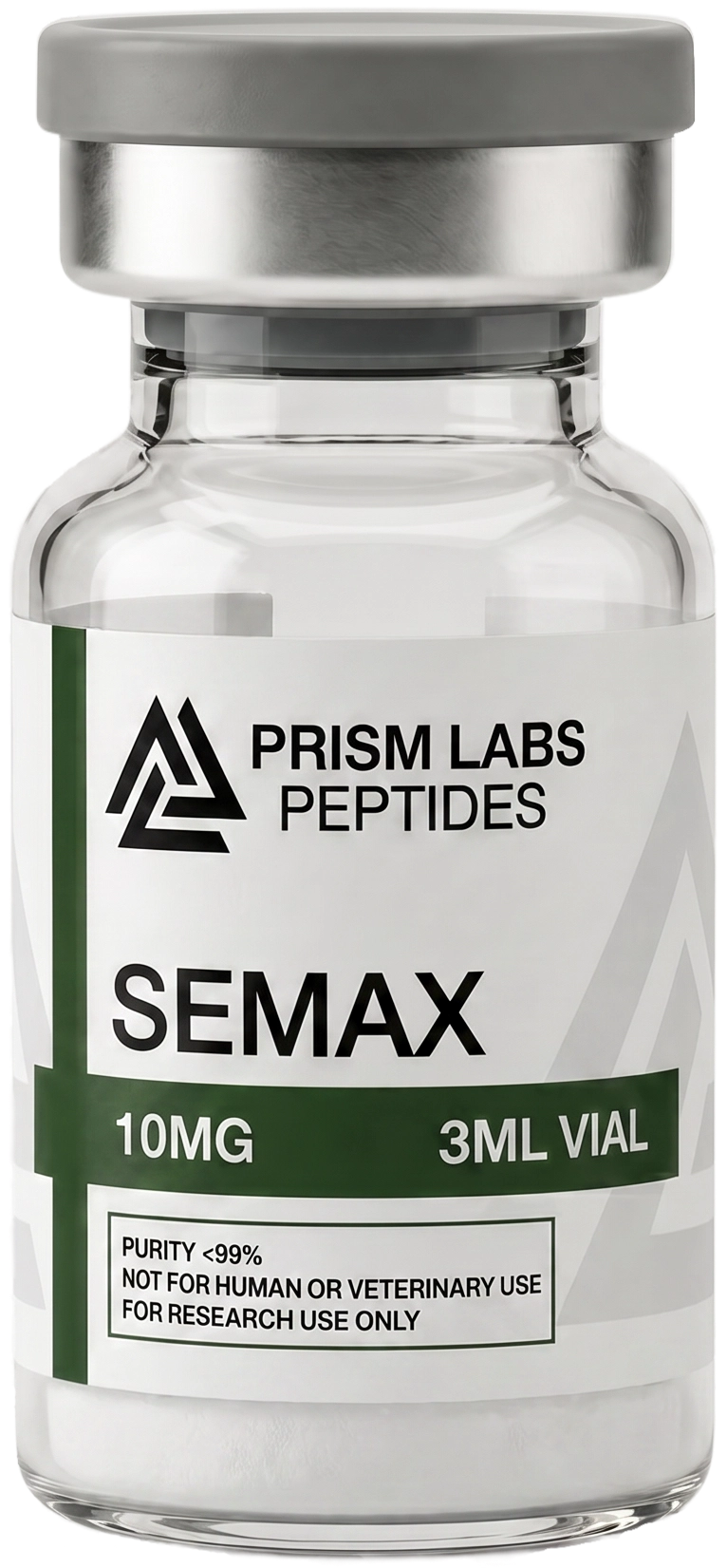
- Starting state: dry powder in the vial; a ready solution in the spray.
- Preparation: the vial needs reconstitution with bacteriostatic water; the spray needs none.
- Concentration: you set a vial’s by the volume of water added; a spray’s is fixed at filling (10 mg in 10 mL is 1 mg per mL).
- Stability: dry powder is the most stable form; any peptide in solution is more exposed to water-driven breakdown.
- Documentation: each needs its own lot and COA. A vial’s report covers the dry powder; a spray’s should cover the solution as filled.

02
How a lyophilized vial works
Lyophilization, or freeze-drying, removes water so the peptide sits in a dry solid. Water speeds chemical breakdown: a 1999 study found that the deamidation rate of a model peptide rose with the water content of the dry solid.
Storage conditions matter even for dry powder. A 2015 FDA laboratory study of a lyophilized peptide hormone found its measured content fell over eight weeks at room temperature and humidity, with particles forming after reconstitution.
That is why vials ship dry and are reconstituted only when needed. The reconstitution calculator turns vial content and water volume into concentration.
Sources: [4] Journal of Pharmaceutical Sciences · 1999 · [5] International Journal of Pharmaceutics · 2015
03
How a premixed nasal spray works
A spray bottle holds the peptide already dissolved in preserved water, with a metering pump that delivers a fixed volume each time.
Because it is already in solution, a spray has no mixing step and its concentration is set at filling. Its lot and COA document the solution as supplied.
04
What research says about the nasal route
Pharmaceutical scientists study the nose as a way to deliver peptides without injection. Reviews describe the olfactory and trigeminal nerves as a possible direct route to the brain that bypasses the blood–brain barrier.
The same reviews list the obstacles: peptides break down quickly, cross membranes poorly and stay in the nasal cavity only briefly, so formulations often need absorption enhancers or special carriers. Results from a formulated drug product do not transfer automatically to a research spray.
Sources: [1] Pharmaceutics · 2022 · [2] Current Pharmaceutical Design · 2021 · [3] The AAPS Journal · 2015
05
Which format fits a lab protocol
A few rules of thumb:
- Choose a vial when the protocol needs a specific concentration, a different solvent, or long-term storage of dry stock.
- Choose a spray when the protocol calls for a fixed, ready-made solution with no reconstitution step.
- Either way, match the format to the published method you follow: studies used their own preparations.
06
The format Prism Labs supplies
Prism Labs supplies every compound as a lyophilized vial, each lot with its own COA. To prepare one, add bacteriostatic water such as ; the reconstitution calculator turns a vial size and a water volume into a concentration.
Each compound’s article in the research library covers its structure, research and the vial sizes it comes in.
A little more clarity
Questions, answered
What is the difference between a peptide nasal spray and a vial?
A vial holds dry powder that you reconstitute to a concentration you choose; a nasal spray is a premixed solution at a fixed concentration in a metered bottle.
Do nasal sprays need reconstitution?
No. They arrive as a ready solution. Lyophilized vials need bacteriostatic water before use.
Which format is more stable?
Dry lyophilized powder. Peptides in solution are more exposed to water-driven breakdown, so store any solution as its label directs.
Does Prism Labs sell peptide nasal sprays?
No. Prism Labs supplies research peptides as lyophilized vials, each lot with its own COA.
Are they for human use?
No. Prism Labs sells its research peptides for laboratory research use only.
Follow the evidence
Sources & reading notes
Open the original record for its methods and limitations. The sources below do not certify the supplied product or its finished formulation.
- Pharmaceutics · 2022 ↗
Review of nose-to-brain peptide delivery, its devices and its limits.
- Current Pharmaceutical Design · 2021 ↗
Review of nasal delivery of proteins and peptides, and methods to improve absorption.
- The AAPS Journal · 2015 ↗
Review of nasal delivery of proteins and peptides to the brain.
- Journal of Pharmaceutical Sciences · 1999 ↗
Water content speeds deamidation of a peptide in dry solids.
- International Journal of Pharmaceutics · 2015 ↗
FDA laboratory study of storage effects on a lyophilized peptide.
Prepared by Prism Labs from the linked source records and public product documentation. Research context only; not a preparation protocol or a claim about outcomes. Send a source correction.
Keep exploring
More from the research library.

vs
Two seven-residue peptides with the same tail and different parents.
Read the article ↗Comparisons
vs
Two unrelated peptides that keep turning up in the same studies.
Read the article ↗Comparisons
vs
Two blends that share three peptides. One extra ingredient makes the difference.
Read the article ↗