Research library / Comparisons
One added chemical group changes how long the peptide stays in the blood.
CJC-1295 comes in two versions. The one with DAC carries a chemical group that bonds it to albumin in the blood, which stretches its half-life to about a week. The version without DAC lacks that group, and no human half-life has been reported for it. They are different compounds, so check which one a label or report describes.
01
At a glance
The main differences:
- Structure: both are the first 29 amino acids of GHRH with four substitutions. Only the DAC version adds the reactive group.
- In the blood: the DAC version bonds permanently to albumin. The other does not.
- Half-life: an estimated 5.8 to 8.1 days with DAC, in healthy adults. No human figure has been reported without DAC.
- Other names: the version without DAC is also called Mod GRF 1–29.
- At Prism Labs: without DAC only, as part of a blend.
Sources: [1] Journal of Clinical Endocrinology & Metabolism · 2006 · [2] Journal of Clinical Endocrinology & Metabolism · 2006 · [3] Endocrinology · 2005 · [5] Frontiers in Endocrinology · 2026
02
What is DAC?
DAC stands for drug affinity complex: a reactive group added to the peptide so it attaches to albumin, the abundant protein in blood. It was built to solve a specific problem: natural GHRH lasts only a short time in circulation.
In the 2005 paper that identified CJC-1295, albumin-bound versions also held up better in a lab test against DPP-IV, an enzyme that breaks down GHRH.
Sources: [4] Drug Testing and Analysis · 2021 · [3] Endocrinology · 2005 · [1] Journal of Clinical Endocrinology & Metabolism · 2006
03
How long does each version last?
With DAC, two 2006 trials in healthy adults estimated a half-life of 5.8 to 8.1 days. A second 2006 paper gives about 8 days.
Without DAC, a 2026 review found no half-life reported in human studies, and no controlled human trials at all. Half-life figures you see online for this version are estimates at best.
Sources: [1] Journal of Clinical Endocrinology & Metabolism · 2006 · [2] Journal of Clinical Endocrinology & Metabolism · 2006 · [5] Frontiers in Endocrinology · 2026
04
Which version do the studies cover?
The human trials above tested the DAC version. Their results don’t carry over to the version without it, because the two behave differently in the blood.
A 2021 anti-doping study also tested them as two separate compounds, and a 2026 review lists them separately too.
Sources: [1] Journal of Clinical Endocrinology & Metabolism · 2006 · [4] Drug Testing and Analysis · 2021 · [5] Frontiers in Endocrinology · 2026
05
How can I tell which one I have?
Read the label and the lot’s certificate of analysis. A label or report that says “with DAC” describes a different compound from one that says “No DAC”.
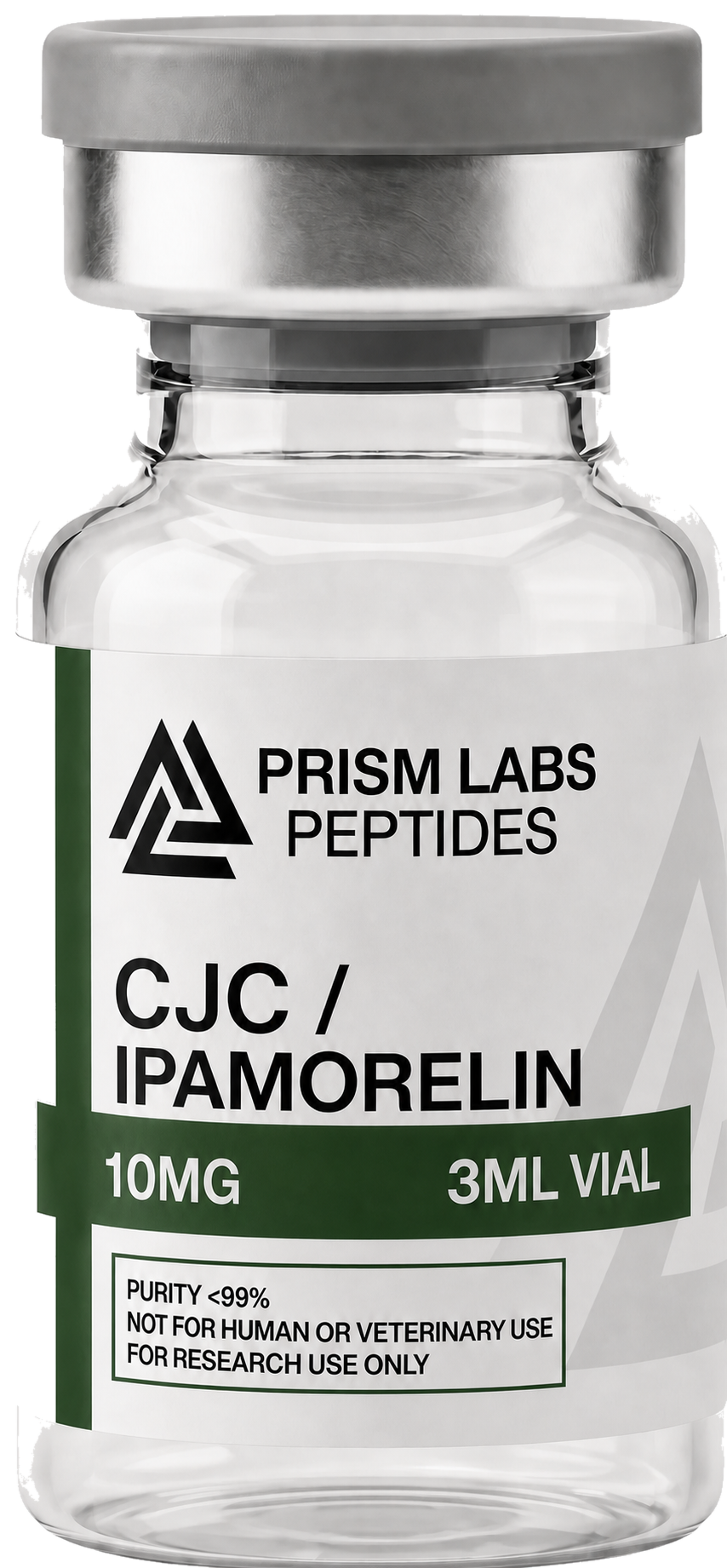
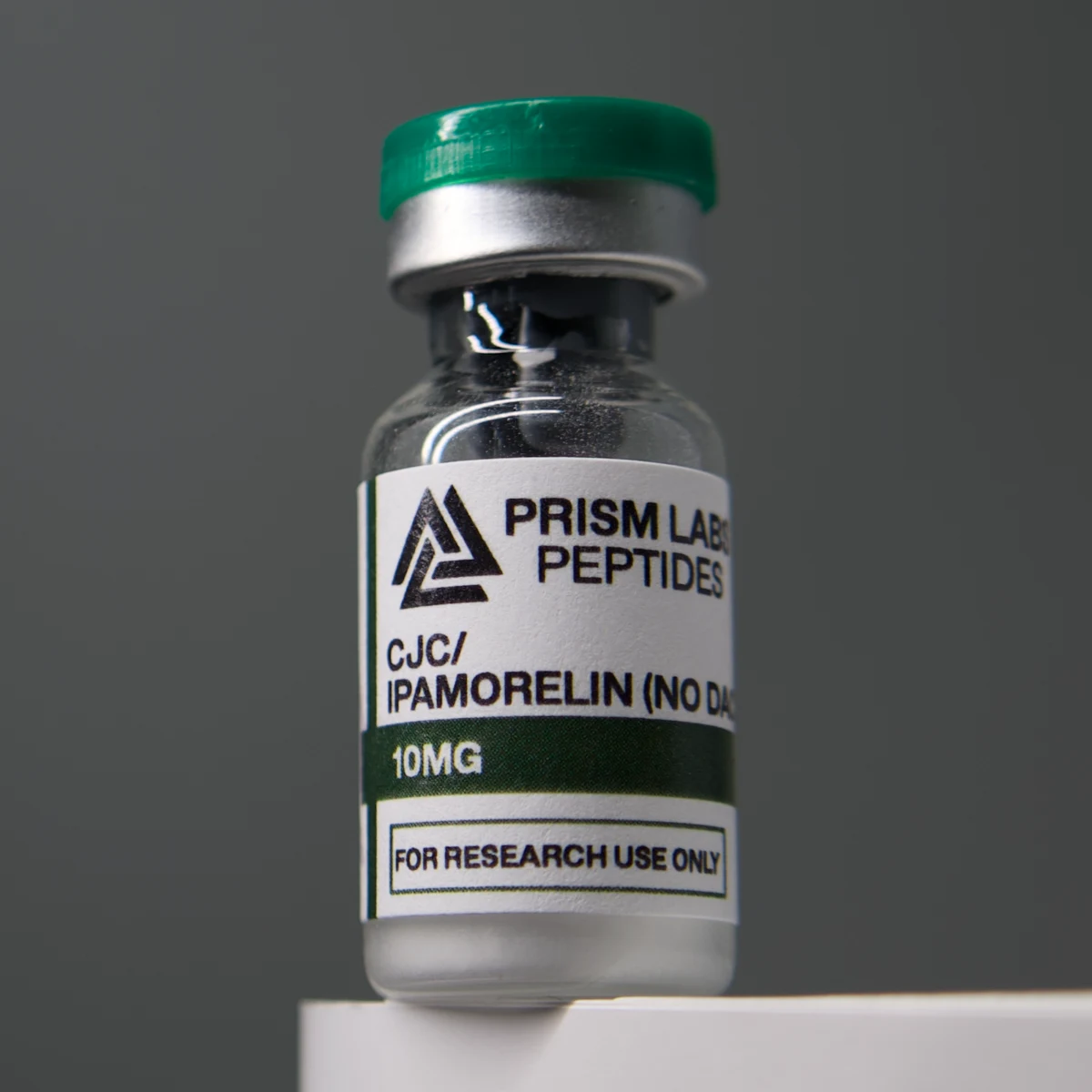
Prism Labs supplies only the version without DAC, in CJC / Ipamorelin (No DAC). Every lot has its own report: how to read a peptide COA.
A little more clarity
Questions, answered
What does DAC stand for?
Drug affinity complex, a reactive chemical group that bonds the peptide to albumin in the blood.
Is CJC-1295 with DAC the same as without?
No. They share the same 29-amino-acid core, but the DAC version adds a reactive group, and the two are treated as separate compounds.
What is the half-life of CJC-1295?
An estimated 5.8 to 8.1 days for the DAC version, in healthy adults. No human half-life has been reported for the version without DAC.
Which version does Prism Labs sell?
Only the version without DAC, as part of a blend with a second peptide.
Are they for human use?
No. Prism Labs sells its peptides for laboratory research use only.
Follow the evidence
Sources & reading notes
Open the original record for its methods and limitations. The sources below do not certify the supplied product or its finished formulation.
- Journal of Clinical Endocrinology & Metabolism · 2006 ↗
Trials of the DAC version in healthy adults: estimated half-life of 5.8 to 8.1 days.
- Journal of Clinical Endocrinology & Metabolism · 2006 ↗
Describes the DAC version’s permanent binding to albumin.
- Endocrinology · 2005 ↗
How reactive derivatives of GHRH(1–29) were built to bond to albumin, and how that protected them from an enzyme.
- Drug Testing and Analysis · 2021 ↗
Anti-doping detection work that lists the versions with and without DAC as separate compounds.
- Frontiers in Endocrinology · 2026 ↗
Review reporting no controlled human studies and no human half-life for the version without DAC.
Prepared by Prism Labs from the linked source records and public product documentation. Research context only; not a preparation protocol or a claim about outcomes. Send a source correction.
Keep exploring
More from the research library.
CJC / Ipamorelin (No DAC)
Two peptides, two receptors, one vial, and what “No DAC” means.
Read the article ↗Compounds
Ipamorelin
A five-residue peptide described in 1998 as the first selective growth hormone secretagogue.
Read the article ↗Comparisons
Tesamorelin vs Sermorelin
One keeps the whole hormone and protects its start. The other keeps only the first 29 amino acids.
Read the article ↗