Research library / Compounds
What is ?
A coenzyme found in every living cell, handled in the lab like a peptide.
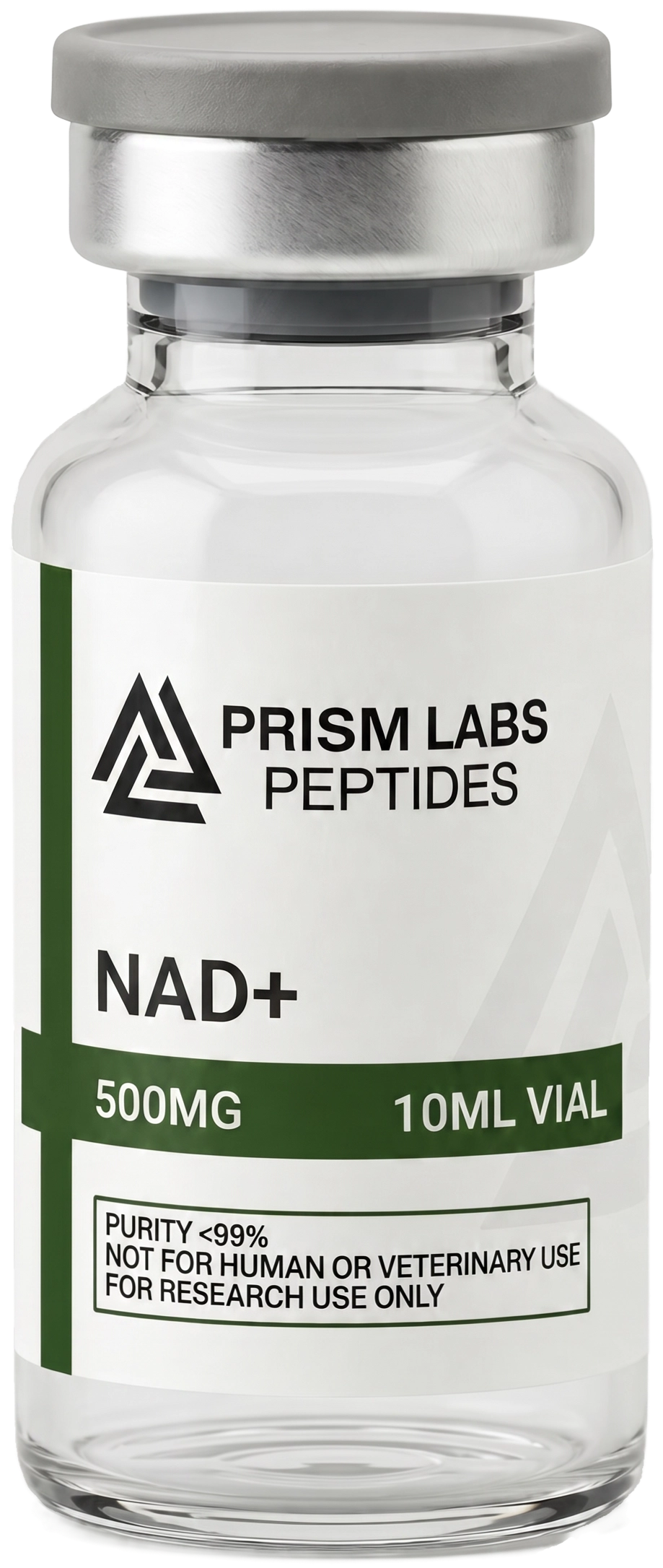
(nicotinamide adenine dinucleotide) is a coenzyme found in every living cell. It carries electrons between the redox reactions of metabolism, and several enzyme families consume it as they work. It is a dinucleotide, not a peptide. Prism Labs supplies it as a lyophilized vial.
01
What it is
The name describes the structure: two nucleotides, one carrying nicotinamide and one carrying adenine, joined through their phosphate groups. It is a coenzyme, a small helper molecule that enzymes need, not a chain of amino acids.
The “+” marks the oxidized form. When it accepts electrons it becomes NADH, and the pair shuttles electrons from one reaction to the next. The reference record for the oxidized form lists C21H27N7O14P2 and 663.4 g/mol (PubChem CID 10897651).
Sources: [1] PubChem · oxidized reference structure · [2] Science · 2015
02
What it does in cells
A 2015 review describes two jobs:
- Electron carrier: it moves electrons between the oxidation–reduction (redox) reactions of metabolism.
- Co-substrate: enzymes such as the sirtuins and PARPs consume it as they work, so cells must keep making more.
The second role ties it to sirtuin research. A 2001 study showed that the sirtuin SIRT1 needs it to remove acetyl groups from the protein p53.
Sources: [2] Science · 2015 · [3] Cell · 2001
03
What researchers have studied
A large literature, mostly in cells and animals, covers:
- How cellular levels change with age, reviewed in 2014 and 2021.
- Sirtuins and other enzymes that depend on it.
- The pathways cells use to make and recycle it.
These are observations in laboratory models. They are not evidence about any use in people.
Sources: [4] Trends in Cell Biology · 2014 · [5] Nature Reviews Molecular Cell Biology · 2021 · [2] Science · 2015
04
Why it sits in a peptide catalog
It is not a peptide, but it is handled like one in the lab: it ships as a lyophilized powder, it is reconstituted with bacteriostatic water, and each lot has its own certificate of analysis.
Related reading: What is ?, a small molecule aimed at an enzyme in nicotinamide metabolism.
05
How it is supplied and stored
ships as a lyophilized (freeze-dried) powder in 500 mg or 1000 mg vials. The powder is stable at room temperature in transit. For lab use it is reconstituted with bacteriostatic water such as .
Concentration is content divided by volume: 500 mg in 5 mL gives 100 mg per mL. The reconstitution calculator handles other combinations.
For storage before and after reconstitution, see how to store lyophilized peptides.
06
How to verify a batch
Every lot has its own certificate of analysis from an independent lab. Read three results separately:
- Identity: confirms the expected compound was detected.
- Purity: the share of the measured material that is the intended compound.
- Content: the amount measured, compared with the label.
Then match the lot number on your vial or bottle to the report, and use the report’s verification link to confirm it with the testing lab. Step by step: how to read a peptide COA.
A little more clarity
Questions, answered
What is ?
Nicotinamide adenine dinucleotide, a coenzyme found in every living cell. It carries electrons in redox reactions and is consumed by enzymes such as the sirtuins.
Is a peptide?
No. It is a dinucleotide coenzyme. In the lab it is handled like a peptide: lyophilized, reconstituted and documented lot by lot.
What is the difference between and NADH?
They are the same molecule in two states. The oxidized form accepts electrons and becomes NADH, which can pass them on.
Does it come as a nasal spray?
No. Prism Labs supplies it as 500 mg and 1000 mg lyophilized vials, each lot with its own COA. How the two formats differ in general: peptide nasal spray vs vial.
Is it for human use?
No. Prism Labs sells it for laboratory research use only.
Follow the evidence
Sources & reading notes
Open the original record for its methods and limitations. The sources below do not certify the supplied product or its finished formulation.
- PubChem · oxidized reference structure ↗
The oxidized form referenced in the product specifications; not a batch measurement.
- Science · 2015 ↗
Review of its roles as an electron carrier and as a co-substrate for sirtuins and PARPs.
- Cell · 2001 ↗
Shows the sirtuin SIRT1 is a coenzyme-dependent deacetylase of p53.
- Trends in Cell Biology · 2014 ↗
Review of the coenzyme and sirtuins in aging research.
- Nature Reviews Molecular Cell Biology · 2021 ↗
Review of how cellular levels change with age.
Prepared by Prism Labs from the linked source records and public product documentation. Research context only; not a preparation protocol or a claim about outcomes. Send a source correction.
Keep exploring
More from the research library.
The first 29 of human GHRH’s 44 amino acids, with nothing added.
Read the article ↗Compounds
A lipid-linked peptide built to act on two related hormone receptors at once.
Read the article ↗Compounds
Part of the hormone α-MSH, rebuilt in 1989 as a cyclic seven-residue peptide to study melanocortin receptors.
Read the article ↗