Research library / Compounds
What is ?
A trade name for peptides based on thymosin beta-4, the actin-binding protein found in most cells.
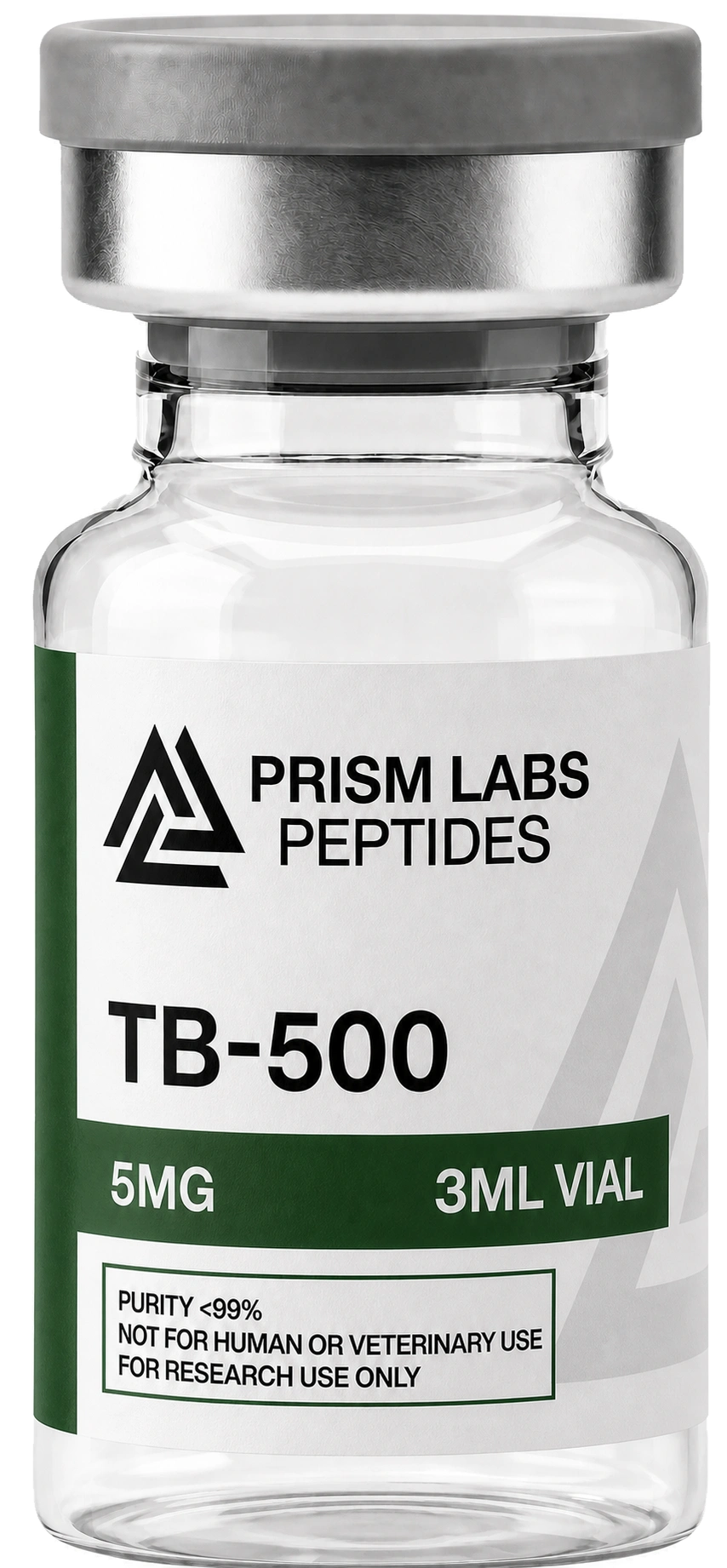
is the name used for synthetic peptides based on thymosin beta-4, a 43-amino-acid protein found in most cells. Anti-doping chemists define it as a short acetylated fragment of that protein, the stretch that binds actin, while some suppliers use the name for the full protein. Prism Labs supplies it as a lyophilized vial.
01
What the name refers to
Thymosin beta-4 is a 43-amino-acid protein. It was isolated from calf thymus and fully sequenced in 1981, when it was still thought to be a thymic hormone.
is a trade name, not a scientific one. In the analytical literature it means a synthetic copy of residues 17–23 of thymosin beta-4 with an acetyl group on the N-terminus (Ac-LKKTETQ). That seven-residue stretch is the part of the protein that binds actin.
Some research suppliers use the same name for full-length synthetic thymosin beta-4. Seven amino acids and 43 are very different molecules, so read the identity result on your lot’s certificate of analysis: the measured mass shows which one the vial contains.
Sources: [1] PNAS · 1981 · [4] Journal of Chromatography A · 2012 · [5] Journal of Chromatography B · 2024
02
What thymosin beta-4 does in cells
Actin is the protein that builds a cell’s internal scaffolding. In 1991, researchers showed that thymosin beta-4 is identical to Fx, a peptide that binds single actin molecules one to one and stops them from joining into filaments.
A 1992 study found that it holds most of the unassembled actin in resting white blood cells. Because it is abundant in many cell types, papers describe it as a major regulator of actin assembly.
Sources: [2] Journal of Biological Chemistry · 1991 · [3] Journal of Cell Biology · 1992

03
What researchers have studied
The protein and its fragments have a mostly preclinical literature:
- Blood-vessel development, including a 2007 study of coronary vessels in mice.
- Cell migration, which analytical papers tie to the 17–23 stretch the fragment copies.
- Tendon repair in rats, in a 2026 study that tested it alone and combined with .
- Metabolism of the acetylated fragment, mapped in human serum in vitro and in rats in 2024.
The 2024 study noted that the biological effects of the fragment itself had not been documented. Most findings come from the full-length protein, so check which molecule a paper used before comparing it with a vial.
These are observations in laboratory models. They are not evidence about any use in people.
Sources: [6] Annals of the New York Academy of Sciences · 2007 · [4] Journal of Chromatography A · 2012 · [7] Joint Diseases and Related Surgery · 2026 · [5] Journal of Chromatography B · 2024
04
vs
They are often sold and studied together, but they are unrelated molecules. comes from thymosin beta-4, an actin-binding protein found in most cells; is a 15-residue fragment of a protein described in gastric juice.
Prism Labs sells each on its own and together as the . Side by side: vs .
05
Where else it appears
06
How it is supplied and stored
ships as a lyophilized (freeze-dried) powder in 5 mg or 10 mg vials. The powder is stable at room temperature in transit. For lab use it is reconstituted with bacteriostatic water such as .
For a vial, concentration is content divided by volume: 10 mg in 2 mL gives 5 mg per mL. The reconstitution calculator handles other combinations.
For storage before and after reconstitution, see how to store lyophilized peptides.
07
How to verify a batch
Every lot has its own certificate of analysis from an independent lab. Read three results separately:
- Identity: confirms the expected compound was detected.
- Purity: the share of the measured material that is the intended compound.
- Content: the amount measured, compared with the label.
Then match the lot number on your vial or bottle to the report, and use the report’s verification link to confirm it with the testing lab. Step by step: how to read a peptide COA.
A little more clarity
Questions, answered
What is ?
A synthetic peptide based on thymosin beta-4. Analytical papers use the name for the acetylated 17–23 fragment (Ac-LKKTETQ); some suppliers use it for the full 43-residue protein. The COA identity result shows which.
Is the same as thymosin beta-4?
Not necessarily. Thymosin beta-4 is the 43-amino-acid protein. Depending on the supplier, the trade name refers to a seven-residue fragment of it or to the full protein.
What does thymosin beta-4 do?
In cells, it binds single actin molecules and keeps them from assembling into filaments. It is one of the main actin-sequestering proteins in many cell types.
Does it come as a nasal spray?
No. Prism Labs supplies it as 5 mg and 10 mg lyophilized vials, each lot with its own COA. How the two formats differ in general: peptide nasal spray vs vial.
Is it for human use?
No. Prism Labs sells it for laboratory research use only.
Follow the evidence
Sources & reading notes
Open the original record for its methods and limitations. The sources below do not certify the supplied product or its finished formulation.
- PNAS · 1981 ↗
Complete amino-acid sequence of thymosin beta-4 from calf thymus.
- Journal of Biological Chemistry · 1991 ↗
Shows thymosin beta-4 is the main actin-sequestering peptide in platelets.
- Journal of Cell Biology · 1992 ↗
Thymosin beta-4 holds most unassembled actin in resting white blood cells.
- Journal of Chromatography A · 2012 ↗
Doping-control method identifying the acetylated 17–23 fragment as the key ingredient of a veterinary preparation.
- Journal of Chromatography B · 2024 ↗
Metabolites of the acetylated fragment in human serum in vitro and in rats.
- Annals of the New York Academy of Sciences · 2007 ↗
Thymosin beta-4 in coronary blood-vessel development in mice.
- Joint Diseases and Related Surgery · 2026 ↗
Rat tendon-repair study of two peptides, alone and combined.
Prepared by Prism Labs from the linked source records and public product documentation. Research context only; not a preparation protocol or a claim about outcomes. Send a source correction.
Keep exploring
More from the research library.
The first 29 of human GHRH’s 44 amino acids, with nothing added.
Read the article ↗Compounds
A lipid-linked peptide built to act on two related hormone receptors at once.
Read the article ↗Compounds
Part of the hormone α-MSH, rebuilt in 1989 as a cyclic seven-residue peptide to study melanocortin receptors.
Read the article ↗