Research library / Guides
Short chains of amino acids, and why one word covers so many different products.
Peptides are short chains of amino acids, the same building blocks that make up proteins. A chain of about 2 to 50 amino acids is usually called a peptide. The word covers natural hormones, prescription drugs, collagen powders and research materials, so it helps to know which one you are looking at.
01
What is a peptide?
A peptide is a chain of amino acids joined by peptide bonds. The order of the amino acids, called the sequence, decides which peptide it is. Change one amino acid and you have a different molecule.
Length varies widely. Peptides in our own catalog, by number of amino acids:
- 3: Glutathione and KPV
- 4: Epitalon
- 7: Semax
- 15: BPC-157
- 16: MOTS-c
- 29: Sermorelin
- 44: Tesamorelin
02
What is the difference between a peptide and a protein?
Length. Proteins are longer chains, and nature draws no sharp line between the two.
US drug regulation does draw one: FDA defines a protein as a chain of more than 40 amino acids with a defined sequence. That makes Tesamorelin, at 44, a protein on paper.
Scientists use the words more loosely. A major 2022 review calls insulin, with 51 amino acids, a peptide.
Sources: [2] eCFR · 21 CFR 600.3 · [1] Signal Transduction and Targeted Therapy · 2022
03
What do peptides do?
Many natural peptides act as hormones, including insulin, oxytocin and vasopressin. Insulin became the first commercial peptide drug in 1923, and more than 80 peptide drugs have now been approved worldwide.
Those approvals apply to those specific, tested drugs. They say nothing about any other peptide, because each sequence behaves differently.
Sources: [1] Signal Transduction and Targeted Therapy · 2022
04
What kinds of peptide products are there?
One word covers very different products:
- Prescription peptide drugs: FDA-approved medicines, tested in clinical trials.
- Compounded peptides: made by a licensed pharmacy for a patient with a prescription, and not FDA-approved. What the 2026 HHS policy changed.
- Collagen peptides: a food and supplement ingredient. Hydrolyzed collagen is a mix of short fragments, broken down from sources such as cow, pig or fish, not one defined sequence.
- Cosmetic peptides: skincare ingredients, including the copper peptide GHK-Cu.
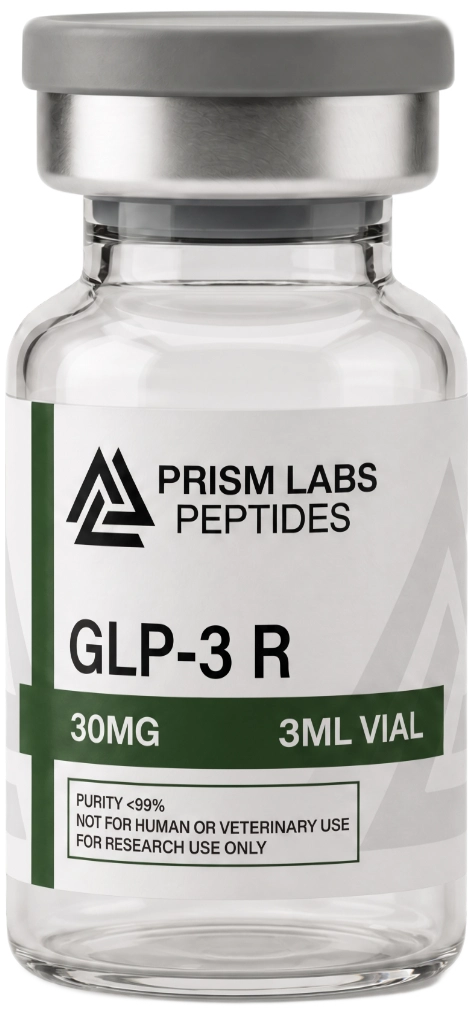
- Research peptides: synthetic peptides sold for laboratory research, not for use in people. What the research-use label means.
Prism Labs sells research peptides only, for laboratory use.
Sources: [3] Molecules · 2019
05
How are peptides made?
Most synthetic peptides are built by solid-phase synthesis, which adds one amino acid at a time to a chain anchored on a solid support. Any step can go slightly wrong, leaving chains that are too short, too long or chemically altered.
Purification removes most of those, though not always all, which is why a supplier should publish a lab report for each lot. What to look for: how to read a peptide COA.
Sources: [4] Journal of Pharmaceutical and Biomedical Analysis · 2014
06
Why aren’t most peptides pills?
Digestive enzymes in the stomach and intestine break peptides apart, so most peptide drugs are given by injection. HHS said the same in its 2026 compounding policy, calling adequate oral bioavailability “inherently difficult and complex” to achieve.
This describes peptides as a class. It is not guidance on using any product.
Sources: [1] Signal Transduction and Targeted Therapy · 2022 · [5] HHS · 503A peptide enforcement discretion policy · 2026
A little more clarity
Questions, answered
What are peptides in simple terms?
Short chains of amino acids, the building blocks of proteins. Your body makes many of them, and others are made in laboratories.
Are peptides the same as proteins?
No. Proteins are longer chains. FDA draws the line at 40 amino acids, though scientists use the words more loosely.
Are collagen peptides the same as research peptides?
No. Collagen peptides are a mix of fragments from animal collagen, sold as a food ingredient or supplement. A research peptide is one synthetic sequence, sold for laboratory use.
Are peptides steroids?
No. Peptides are chains of amino acids. Steroids are a different class of molecule, built on a ring structure.
Are Prism Labs peptides for human use?
No. Prism Labs sells them for laboratory research use only.
Follow the evidence
Sources & reading notes
Open the original record for its methods and limitations. The sources below do not certify the supplied product or its finished formulation.
- Signal Transduction and Targeted Therapy · 2022 ↗
Review of therapeutic peptides: more than 80 approved worldwide, and why most are injected.
- eCFR · 21 CFR 600.3 ↗
FDA’s definition: a protein is an alpha amino acid polymer with a defined sequence of more than 40 amino acids.
- Molecules · 2019 ↗
Review of hydrolyzed collagen: low-molecular-weight peptides of 3–6 kDa from bovine, porcine and marine sources.
- Journal of Pharmaceutical and Biomedical Analysis · 2014 ↗
Review of the impurities that arise in synthetic peptides.
- HHS · 503A peptide enforcement discretion policy · 2026 ↗
Limits compounded products to a single peptide, and explains why oral peptides are difficult.
Prepared by Prism Labs from the linked source records and public product documentation. Research context only; not a preparation protocol or a claim about outcomes. Send a source correction.
Keep exploring
More from the research library.
What are research peptides?
What the RUO label means, where it comes from, and what it does not promise.
Read the article ↗GuidesHow to read a peptide COA
Three results, three different questions. Read them separately.
Read the article ↗GuidesWhere to buy peptides
Eight checks that separate a documented supplier from a risky one.
Read the article ↗